
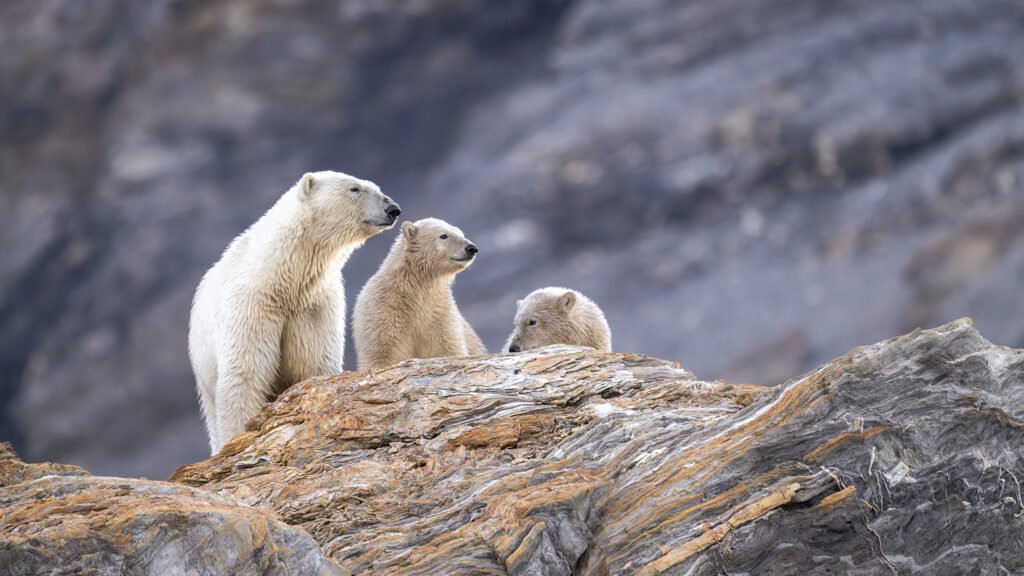
About Polar Bears
Polar Bear – The Arctic’s Apex Predator
The polar bear (Ursus maritimus) is one of the most iconic and powerful carnivores on the planet.
Native to the Arctic Circle, polar bears are uniquely adapted to survive in extreme cold, icy waters, and vast tundras.
As the world’s largest land carnivore, the polar bear plays a critical role in maintaining the health of the Arctic ecosystem.
Where Do Polar Bears Live?
Polar bears live in the Arctic regions of Canada, Alaska (USA), Greenland, Russia, and Norway (Svalbard).
They rely heavily on sea ice to hunt, breed, and migrate.
As ice melts due to climate change, polar bears are forced to travel longer distances in search of food.
What Do Polar Bears Eat?
Polar bears are obligate carnivores with a diet focused primarily on:
Seals (especially ringed and bearded seals)
Occasionally walrus, beluga whale carcasses, and birds
When food is scarce, they may scavenge on vegetation or human waste
Polar Bear Characteristics
Weight: Males can weigh up to 1,600 pounds (720 kg)
Length: Up to 10 feet (3 meters)
Fur appears white but is actually translucent and helps with camouflage
Thick blubber layer provides insulation
Strong swimmers – can swim for days across icy waters
Are Polar Bears Endangered?
Polar bears are classified as vulnerable by the IUCN.
Their survival is threatened by:
Climate change – sea ice is rapidly disappearing
Pollution – toxins accumulate in Arctic food chains
Oil drilling and shipping disturb natural habitats
Human-wildlife conflict in coastal settlements
Polar Bear Facts – Did You Know?
They can smell seals from over 1 km away under thick snow
Polar bears can swim over 100 km without rest
Their skin is actually black to absorb and retain heat
They are almost entirely carnivorous—the most carnivorous of all bear species
Best Places to See Polar Bears in the Wild
Churchill, Manitoba (Canada) – nicknamed the “Polar Bear Capital of the World”
Svalbard, Norway – excellent for Arctic wildlife tours
Wrangel Island, Russia – UNESCO World Heritage Site
Alaska, USA – remote locations like Kaktovik
Why Protect Polar Bears?
Polar bears are a keystone species in the Arctic.
Their decline signals dramatic changes in the ecosystem due to global warming.
By protecting polar bears, we also protect countless other species and the future of the Arctic.